

The owner of a typical Spring Hill home pays the city about $76 a month in property tax. Every $100 you spend at a store inside city limits sends about $1.36 to the city.
The city counts on both. In the budget year that ended June 30, 2025, Spring Hill's main operating budget took in slightly more from sales tax ($17.8 million) than from property tax ($17.4 million).
This guide explains where the city's money comes from, what it pays for, and what that means for you.
The quick answers
- The city's main checking account is called the General Fund. It pays for police, fire, streets, parks, the library and city offices. For July 2026 through June 2027, it plans on $66.9 million in revenue.
- Property tax is the biggest piece, about 39%. Sales tax is next, about 27%. Money shared by the state is about 13%.
- Fire and police together take about 44% of planned spending.
- Water and sewer bills go into a separate account. They pay for the water and sewer system, not for police or parks.
- Fees paid by builders are dropping fast because of the sewer moratorium. Those fees help pay for new roads and other projects that growth requires.
Where does the city's money come from?
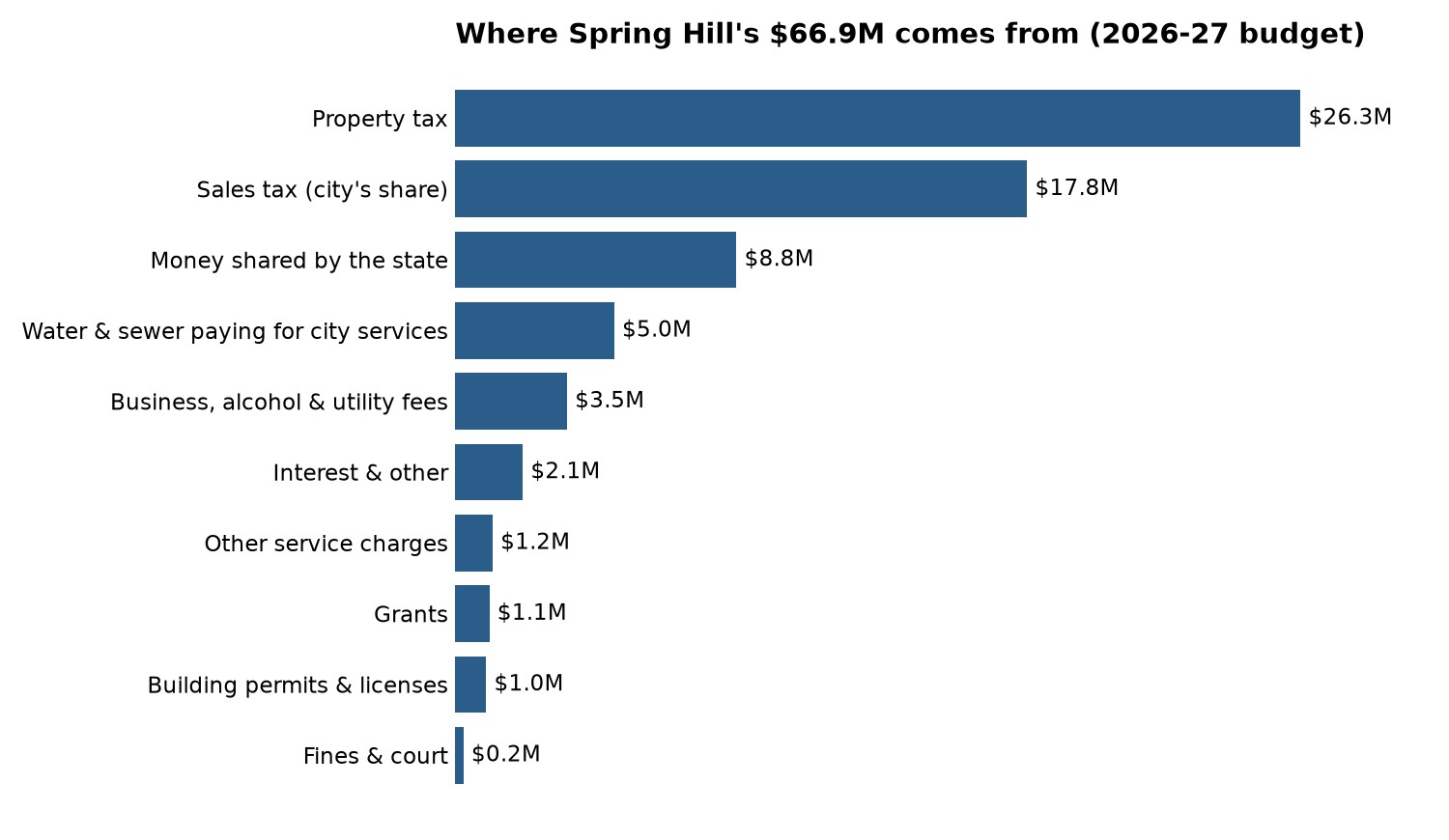 Bar chart: where Spring Hill's $66.9 million comes from in the 2026-27 budget
| Source | 2026-27 | Share |
|---|---|---|
| Property tax | $26.3M | 39% |
| Sales tax (city's share) | $17.8M | 27% |
| State-shared money | $8.8M | 13% |
| Water & sewer paying for city services | $4.9M | 7% |
| Business, alcohol & franchise taxes/fees | $3.5M | 5% |
| Interest & other | $2.1M | 3% |
| Grants, permits, fines & other fees | $3.4M | 5% |
| Total | $66.9M | 100% |
Water & sewer pays the city for services like billing, IT and engineering. Gas and cable companies pay franchise fees to the city.
The citywide budget across all accounts is $151.7 million. Most of the rest is the water and sewer system, which plans on about $36.2 million a year in water and sewer bills.
What does my property tax actually pay for?
Spring Hill's city tax rate is $0.739 for every $100 of "assessed value." In Tennessee, a home's assessed value is 25% of what the county says it is worth.
Example: a $493,800 home. That is the Census Bureau's median value for an owner-occupied home in Spring Hill. Your county's appraisal of your own home may be different.
- $493,800 × 25% = $123,450 taxed value
- $123,450 ÷ 100 × $0.739 = about $912 a year to the city, or about $76 a month
The county takes a bigger bite. Yearly tax on that same home in 2026:
| Maury side | Williamson side | |
|---|---|---|
| County rate (per $100) | $1.369 | $1.27 |
| County tax | ~$1,690 | ~$1,568 |
| City tax | ~$912 | ~$912 |
| Total | ~$2,602 | ~$2,480 |
On the Williamson side, the city bills its tax separately from the county.
Where your $912 goes. If your city tax were spent the same way as the city's main budget, it would break down roughly like this:
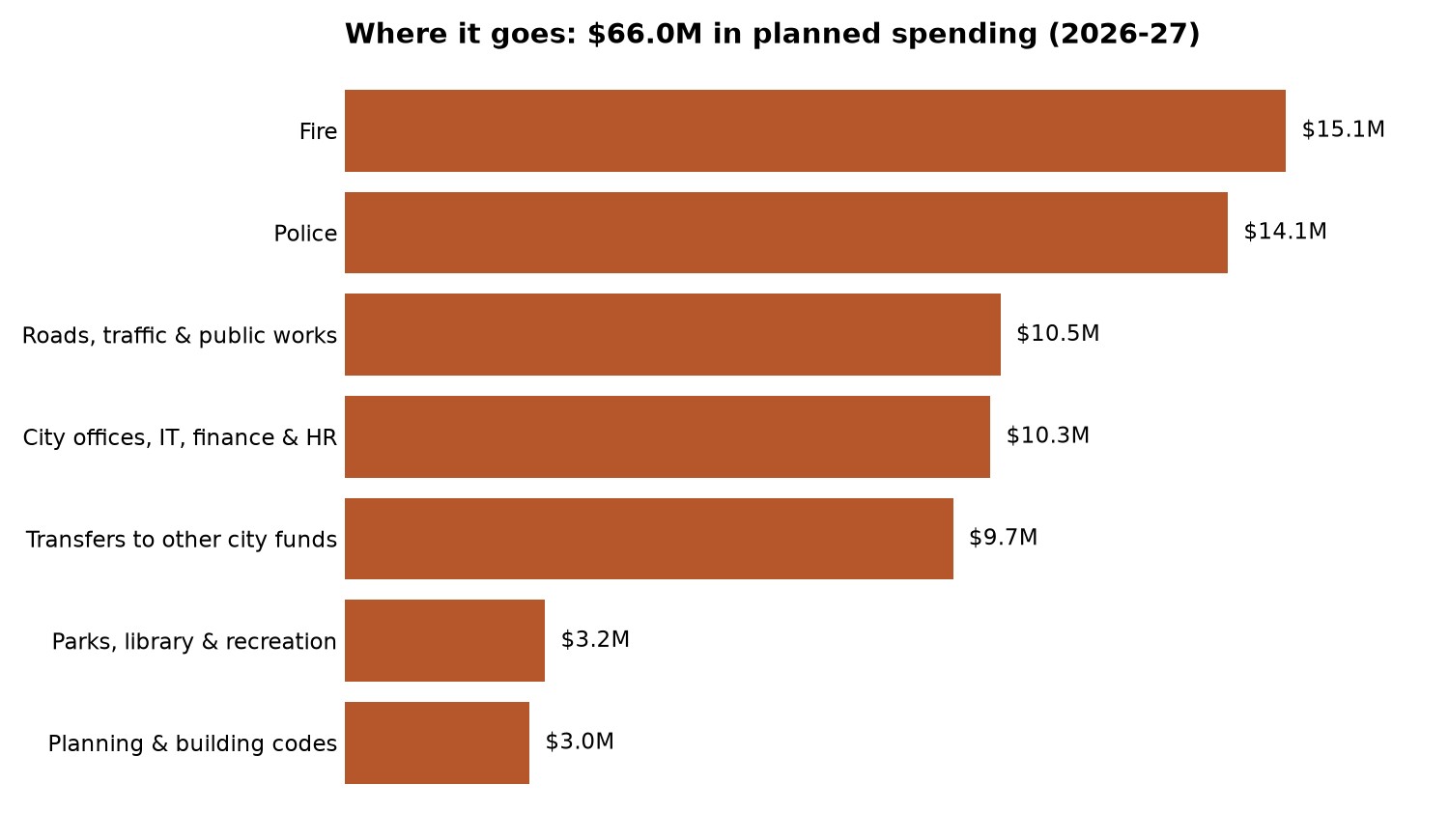 Bar chart: where Spring Hill's $66.0 million in planned spending goes in 2026-27
| Pays for | Share | Of $912 |
|---|---|---|
| Fire | 23% | ~$208 |
| Police | 21% | ~$196 |
| Roads, signals & public works | 16% | ~$145 |
| City offices, IT & staff | 16% | ~$143 |
| Transfers to other city accounts | 15% | ~$135 |
| Parks, library & senior center | 5% | ~$44 |
| Planning & inspections | 4% | ~$41 |
Did my city tax rate go up?
The rate has been $0.739 since the 2022 tax year in both counties. Ten years ago it was about $0.59. It peaked at $0.96 (Maury side) and $1.01 (Williamson side) in the 2020 tax year.
Your bill can still go up when your home's value goes up. Maury County updated every property's value in 2026, and total value countywide rose about 43%. When that happens, Tennessee law requires the state to calculate a lower "break-even" rate that would bring in the same money as last year. For Spring Hill, that rate was $0.6476.
- Maury County and Columbia cut their rates to that break-even level.
- Spring Hill kept $0.739. The vote was 8–1, with Alderman Jimenez voting no.
You may have seen two different numbers for what keeping the rate brings in:
- City staff memo: about $3.1 million. This is the extra money compared with the break-even rate.
- City press release: about $1.95 million. This matches the increase in projected Maury-side property tax in the May draft budget, compared with the previous year's budget.
They measure different things, and both come from the city. The city said the extra money will go to new police and fire positions, a new fire truck, and city building projects.
Where does my sales tax go?
Spring Hill's sales tax rate is 9.75%. That is the state's 7% plus a 2.75% local tax set by the county. Maury and Williamson both charge 2.75%, the most Tennessee law allows. On groceries, the state's part is 4% instead of 7%, but the 2.75% local part still applies.
Where your $100 at a Spring Hill store goes:
| Piece | Of $100 |
|---|---|
| State sales tax (7%) | $7.00 |
| Local sales tax (2.75%) | $2.75 |
| ↳ Half to county schools | ~$1.37 |
| ↳ Half to the city | ~$1.37 |
| City keeps, after a 0.75% state fee | ~$1.36 |
The $7 goes to the state of Tennessee. The city gets a small share back based on how many people live here, not on where you shop.
The catch: it depends on where the store is. That $1.36 goes to the city where the sale happens. Shop in Franklin or Thompson's Station, and that city gets the share instead. Online orders are generally taxed where they are delivered, so a delivery to a Spring Hill address counts for Spring Hill.
In 2025, sales tax from stores on the Maury County side brought the city $11.0 million. Stores on the Williamson side brought $6.8 million.
What does the state send back, and why did it jump?
The state shares some of its taxes with cities: part of the state sales tax, beer tax, and payments from TVA, the federal power agency. Most of it is divided up by population.
Until 2026, the state counted cities at their last census population unless a city paid for its own recount. A 2025 state law switched to yearly population estimates. In the state's 2026 count, Spring Hill went from 50,321 to 61,336 people, about 22% more.
That change shows up in the budget. The city's share of state sales tax is budgeted at $7.87 million for 2026-27, up from $6.15 million budgeted the year before. State gas tax money, which goes to a separate street repair account, is budgeted at $2.29 million, up from $1.86 million collected in 2025.
Why the sewer moratorium hits the budget
When builders put up new homes and businesses, they pay fees. Those fees are meant to make growth pay for itself, for things like new roads, parks and fire stations. Most of the money can only be spent on growth-related projects, not on everyday costs.
The city has paused most new sewer hookups. With less building, those fees are dropping fast:
| Fee | 2025 | 2026-27 |
|---|---|---|
| Building permits | $2.75M | $0.82M |
| Impact fees* | $4.19M | $1.31M |
| Adequate facilities tax* | $4.08M | $1.13M |
*Can only be spent on growth projects. The adequate facilities tax, charged on new construction, also pays off old debt. Building permit money goes into the main budget.
What it means for you: the city plans to move $9.56 million out of its impact fee savings for projects this year. That would bring the account down from $11.3 million to about $3.2 million. If building stays slow, there is less growth money for the next road or fire station. That puts more pressure on the general budget, which is mostly property and sales tax.
What happens when a big store opens in town?
Using the $1.36-per-$100 math, a store selling $100 million a year in taxable goods would send roughly $1.4 million a year to the city. That's about 2% of the city's main budget. A store like the planned Sam's Club would also pay property tax, which is figured on 40% of a business's value instead of the 25% used for homes. The catch: some of those sales would just move over from other Spring Hill stores, and the city gains nothing from those. The real gain is spending that would otherwise leave town.
New employers like Medacta help a different way. They mostly add property tax, at the higher 40% business rate, rather than sales tax.
How does Spring Hill compare with its neighbors?
City property tax rates, per $100 of taxed value, 2026:
- Franklin: $0.296.
- Columbia: $0.6068, after cutting to its break-even rate.
- Spring Hill: $0.739.
- Thompson's Station: $0.103.
Home values and the services each city provides differ, so a lower rate doesn't always mean a lower bill.
What it means for you
- Shopping in town helps pay for city services. About $1.36 of every $100 you spend at a store in Spring Hill goes to police, fire and roads here. Spend it outside Spring Hill and that money goes to another city.
- Your property tax bill depends on your home's value, not just the rate. Check your appraisal notice. If you think the value is wrong, contact your county assessor's office about an appeal.
- Slower growth means fewer builder fees. Less of that money can mean more pressure on the main budget, and that is where your property tax goes.
- The state count matters. The new yearly population estimates gave Spring Hill about $1.7 million more in budgeted state sales tax money this year.
What to watch at budget time (April–June)
- The proposed tax rate vs. the "break-even" rate. If the city wants to go above the break-even rate, it must advertise that and hold a public hearing, which is your chance to speak.
- Sales tax projections. Watch whether new big stores are counted in the estimates.
- Impact fee balances. That account is projected to fall to about $3.2 million.
- New police and fire positions. They are the biggest and fastest-growing costs.
- The schedule. Budget hearings happen at Board of Mayor and Aldermen meetings, usually in May and June. Agendas are posted at springhilltn.org.
Related
- Sam's Club is coming to Spring Hill
- Medacta in Spring Hill
- Spring Hill's sewer moratorium, explained
Sources
- City of Spring Hill, Ordinance 26-10, FY2026-27 Budget (line items)
- City of Spring Hill, FY2026-27 budget fund summaries
- Ordinance 26-09 tax rate staff memo
- BOMA budget packet, May 5, 2026 (proposed budget)
- City of Spring Hill, "BOMA Passes Balanced FY27 Annual Budget" (June 15, 2026)
- BOMA minutes, June 15, 2026 (vote on Ordinance 26-09)
- City of Spring Hill audited financial statements, year ended June 30, 2025 (CliftonLarsonAllen), including the property tax rate history
- U.S. Census Bureau QuickFacts, Spring Hill city, Tennessee
- Main Street Maury, "Closer look at Maury County's approved FY 2026-27 budget"
- Main Street Maury, "Property assessments, taxes: What to know"
- Williamson County Trustee, 2026 Property Tax Rates
- TN Department of Revenue, 2025 Legislative Summaries (Public Chapters 355 and 501)
- TNECD, 2026 Certified Population report